Dakota County Septic Compliance: What Sellers and Buyers Must Do
Dakota County Ordinance 113 makes a septic compliance inspection part of selling a home on a septic system. This guide explains the triggers, the inspection, the pass/fail/escrow outcomes, and how Scott County compares.
The short version
If a Dakota County property served by a septic system is sold or transferred, a compliance inspection report must be completed by an MPCA-licensed compliance inspector. If the system passes, the seller provides a certificate of compliance. If the seller cannot provide that certificate by the time of transfer, the seller must give the buyer security through an escrow agreement so a complying system is guaranteed to be installed.
This page summarizes Ordinance 113 in plain language for planning. It is not legal advice; your closer or attorney and the Dakota County Environmental Resources office are the final word for a specific transaction.
Who triggers the inspection
The trigger is the transfer itself. Ordinance 113's compliance inspection requirement (Section 9.02 of the ordinance) applies to the transfer or sale of all properties served by a septic system, however the home is sold. The same section also triggers inspections when a permit is needed for the system, and when a property expands or changes use in a way that may affect the system.
Two situations surprise sellers. First, a system that works fine day to day can still be noncompliant on paper, because the inspection judges groundwater protection, not convenience. Second, the requirement does not wait for a problem: even a well-maintained system needs a current inspection document for the transfer file. Starting when you decide to list, not when you accept an offer, is the best move a Dakota County seller can make.
Scott County sellers face a different rulebook, covered in the comparison section below: no sale-triggered county inspection, but a state disclosure duty and several permit-based triggers.
What the inspector actually checks
Tank watertightness
Dakota County builds pumping into the compliance inspection: the tank is pumped so its watertightness can be confirmed. A watertight tank certification less than three years old, signed by a licensed maintainer, can satisfy this requirement without re-pumping. Cracked, corroded, or leaking tanks are among the most common failure findings on older systems.
Hydraulic function
The inspector looks for sewage going anywhere it should not: surface discharge, seepage, ponding over the treatment area, or backups in the home. Surfacing effluent or discharge to a ditch or surface water is treated as an imminent threat to public health — the most serious category in the ordinance.
Vertical separation
The soil treatment area must keep a required depth of unsaturated soil between its bottom and the seasonal high water table or bedrock. Dakota County allows a 15% reduction of that separation for systems built after March 31, 1996, to account for settling and measurement variation. Insufficient separation is the classic paper failure: the system seems to work, but sewage reaches groundwater under-treated.
What is not checked
For existing systems, Minnesota inspection practice does not re-evaluate system size, setbacks, past use, or remaining lifespan. The question is narrower: does this system, today, protect public health and groundwater? That is why an inspection is not a warranty.
The three outcomes: pass, fail, or escrow
Pass: certificate of compliance
The inspector issues a certificate of compliance, the seller provides it for the transfer, and the septic file is closed for this transaction. Under Minnesota rules it is generally valid three years for an existing system, five for a new one, unless evidence of noncompliance surfaces. Keep it with the home's permanent records.
Fail: notice of noncompliance
A failing system gets a notice of noncompliance describing what failed. Dakota County then runs on deadlines: a system determined not to be protective of groundwater must be upgraded, repaired, replaced, or abandoned within 10 months of the owner receiving the notice, and an imminent threat to public health or safety within 30 days. In a sale, those deadlines usually convert into negotiation — the seller fixes it before closing, the price absorbs it, or the parties use escrow.
Escrow: the closing proceeds, the obligation remains
When the seller fails to provide a certificate by transfer, Ordinance 113 requires the seller to provide the buyer sufficient security in the form of an escrow agreement to assure installation of a complying system. The county summary requires security that is sufficient, without fixing a percentage. In Minnesota closing practice, that security is commonly set at 125% of a licensed installer's written estimate for the complying system, or 110% of a signed contract price — the formulation used in Minnesota transfer ordinances in this region. Confirm the amount and escrow holder (typically a licensed closer, attorney, or financial institution) with your closing team, and treat 125% as the planning number until they tell you otherwise.
A realistic closing timeline
- At listing (best) or at offer (latest): order the inspection. Inspectors serving Dakota County book out during the selling season.
- Week 1–2: the inspector locates and inspects the system, pumping the tank if needed, and files the certificate or notice within about 15 days.
- On a pass: the certificate goes to the closer and the file is done. On a fail: get a written estimate from a licensed installer immediately, because every remaining path — repair, credit, or escrow — is built on that number.
- Before closing: the parties document the chosen path in the purchase agreement or an escrow agreement, including who performs the work, the deadline, and how funds release.
- After closing (escrow cases): the buyer completes the installation, obtains the certificate of compliance for the new system, and the escrow closes out per its terms.
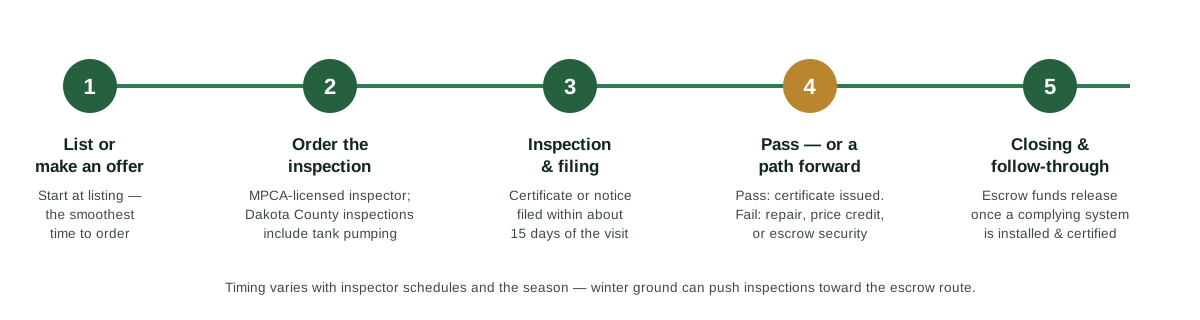
Winter note: frozen ground and snow cover can make a full inspection impractical — precisely the situation escrow agreements exist for.
Seller duties vs. buyer duties
| Seller | Buyer |
|---|---|
| Disclose the system in writing under Minnesota law, including compliance status and any inspection reports in hand | Read the disclosure and any certificate or notice before closing |
| Arrange the compliance inspection in time for the transfer, or provide escrow security if no certificate can be provided | Confirm the closing file contains the certificate or a signed escrow agreement |
| Fund the escrow from sale proceeds when that route is used | If escrow is used, complete the installation and obtain the new certificate within the agreement's deadline |
| Meet county correction deadlines while still the owner | After transfer, own the deadlines and obligations the agreement and ordinance assign to the property |
Minnesota's disclosure duty (Minn. Stat. § 115.55) applies in both counties and is separate from the inspection: the seller must tell the buyer, in writing, how sewage is managed, describe the system and its location, state what the seller knows about its compliance status, and attach any inspection report the seller has. A seller who fails to disclose can be liable for the cost of bringing the system into compliance.
The replacement path after a failed inspection
Most failed Dakota County systems end in replacement rather than repair, because the common failures — separation and watertightness — are structural. The path runs: written estimate from a licensed installer, site evaluation and design, county construction permit, installation with county inspection, and a fresh certificate of compliance. Dakota County does not allow homeowner-installed systems; everyone performing the work must hold the appropriate MPCA license. Our replacement guide and cost guide cover the work and the numbers in detail.
Document checklist for the closing file
- Seller's written septic disclosure statement (required statewide)
- Certificate of compliance, or notice of noncompliance with the installer's written estimate
- Tank pumping / watertightness records, if relied on for the inspection
- Escrow agreement naming the holder, amount, work, deadline, and release conditions (escrow cases)
- Any prior permits, as-built drawings, and inspection reports for the system
- For new systems: construction permit, as-built record, and the new certificate of compliance
Working through a sale? Download or print the seller’s closing checklist — the same documents and steps on one page, with boxes to check off. A PDF version is available too.
Scott County, briefly, for comparison
Scott County's Ordinance No. 4 takes a different approach: inspections are triggered by new or replacement work, permits or variances to alter a system, bedroom additions, changes in use, and land splits — not by a sale alone, though state disclosure still applies and buyers or lenders may require one in the purchase agreement. Do not assume a rule from one county travels to the other.
Scott County — Ordinance No. 4
Inspection at sale? No — a sale by itself is not an inspection trigger.
What triggers an inspection: new or replacement work, permits or variances to alter a system, bedroom additions, changes in use, and land splits.
Still required at every sale: the seller's written septic disclosure under Minnesota law; cities and lenders may add their own requirements.
Dakota County — Ordinance 113
Inspection at sale? Yes — a compliance inspection is required at the transfer or sale of every property served by a septic system.
What triggers an inspection: the transfer itself, plus permits for the system and expansions or changes of use that may affect it.
If no certificate by transfer: the seller provides the buyer security through an escrow agreement so a complying system is guaranteed.
Sources
- Dakota County — Ordinance 113 standards summary (inspection, escrow, timeframes, licensing)
- Minnesota Pollution Control Agency — SSTS inspections (who may inspect, and what inspections cover)
- MPCA — SSTS individual certification (licensing categories)
- Minnesota Statutes § 115.55 (seller disclosure duties)
- Scott County Ordinance No. 4 (full text hosted by the City of Elko New Market; see § 7.03 for inspection triggers)
Rules change and individual properties carry quirks. Verify anything deadline-critical with Dakota County Environmental Resources or Scott County Environmental Health before you rely on it.
Last updated: October 2026
Dakota County compliance questions
Who has to get the inspection, the seller or the buyer?
In Dakota County, the requirement attaches to the transfer, and in practice the seller arranges and pays for the inspection because the seller must be able to provide a certificate or escrow security. Purchase agreements often assign the task explicitly.
How long does the whole inspection process take?
Scheduling is the variable: inspectors in the south metro book out one to three weeks in the busy season, the field visit takes a few hours, and the certificate or notice is filed within about 15 days of the inspection. Started a month before closing, it is unremarkable.
What exactly does the inspector check?
Three things, in plain terms: whether sewage is surfacing, seeping, or backing up; whether the tank is watertight, which in Dakota County means the inspection includes pumping unless a recent watertightness certification covers it; and whether the soil treatment area keeps the required vertical separation from seasonal high water or bedrock. The inspection does not re-score system size or setbacks for existing systems.
My system failed. Can the sale still close?
Usually, yes. The common solutions are to complete a repair or replacement before closing, to credit the buyer, who completes the work by agreement, or to use the Dakota County escrow route: the seller funds security, commonly calculated at 125% of a written estimate, so a complying system is guaranteed after closing.
Does Scott County require the same thing?
No. Scott County Ordinance No. 4 does not make a sale, by itself, an inspection trigger; its triggers are permits, additions, splits, changes of use, and similar events. But Minnesota's written septic disclosure is required at every sale in both counties, some cities add rules, and lenders frequently require inspections contractually.
What if the property is bank-owned, in an estate, or vacant?
The Dakota County requirement follows the property transfer, not the seller's circumstances, so estates and investors should plan on the same inspection or escrow path; specific exemptions, if any apply, should be confirmed with the county before the agreement is signed. Vacant land with no system has nothing to inspect.
Can an old certificate be reused?
If the property already has a certificate of compliance for an existing system that is still within its validity — generally three years from issue under Minnesota rules, five for a newer system — it may satisfy the transfer requirement, provided nothing suggests the system has since become noncompliant. Locate the document early; memory without the certificate rarely satisfies a closer.
Who pays for escrow and what happens to leftover funds?
The escrow is funded from the seller's side of the transaction under the ordinance's security requirement, in the amount the agreement specifies. Funds are released as the complying system is installed and certified, and any balance returns according to the escrow agreement's terms.
Get matched with a certified inspector or installer
Scott County Septic is a matching service, not a contractor. Your request goes to one independent, MPCA-licensed local installer — never to a call list.
Request received — thank you.
Your matched installer will review your details and contact you about next steps.